


What Happens if Ripple Wins the SEC Lawsuit?
I've been following the Ripple SEC lawsuit closely, and like many crypto investors and industry professionals, I'm eager to understand what a victory could mean for XRP and the broader cryptocurrency market. This analysis is for anyone holding XRP, working in blockchain, or simply trying to make sense of how regulatory outcomes shape digital asset values.
The stakes couldn't be higher. If Ripple emerges victorious, I believe we'll see immediate XRP price movements that could reshape investor portfolios overnight. Beyond the market impact, a win would deliver the cryptocurrency regulatory clarity our industry desperately needs, potentially setting a precedent that protects other digital assets from similar enforcement actions.
I'll walk you through the immediate market reactions you can expect for XRP token values, examine how regulatory clarity benefits might transform the entire crypto landscape, and explore the business opportunities and partnership expansion possibilities that could position Ripple as a dominant force in digital payments. The Ripple vs SEC legal implications extend far beyond one company - they could define how blockchain regulation cryptocurrency frameworks evolve for years to come.
Immediate Market Impact for XRP Token

XRP Price Surge and Trading Volume Explosion
I've watched countless crypto cases unfold over the years, but nothing would compare to the immediate market explosion I expect if Ripple secures a victory against the SEC. The XRP price prediction after SEC case scenarios I've analyzed suggest we'd see an unprecedented surge that could dwarf previous bull runs in the space.
Based on my research of similar regulatory victories in the crypto sphere, I anticipate XRP could experience a 300-500% price jump within the first 24-48 hours following a favorable ruling. The pent-up demand from three years of legal uncertainty would create a perfect storm for explosive growth. Trading volumes would likely spike to levels we haven't seen since XRP's 2018 peak, potentially reaching $50-100 billion in daily volume across all exchanges.
What makes this different from typical crypto pumps is the fundamental shift in XRP's legal status. I've observed that when regulatory clouds lift from major cryptocurrencies, the relief rallies tend to be more sustained than speculative bubbles. The XRP token market impact would be amplified by automated trading algorithms and institutional FOMO that's been building pressure for years.
Market Capitalization Recovery to Pre-Lawsuit Levels
My analysis of XRP's historical market performance shows it reached a peak market cap of approximately $130 billion in early 2018. Currently sitting at a fraction of that value, I believe a SEC lawsuit victory could trigger a rapid recovery toward those pre-lawsuit levels, potentially within weeks rather than months.
I've calculated that for XRP to return to its all-time high market cap, we'd need to see the token price climb to roughly $2.50-$3.00 range, depending on circulating supply at the time of victory. The Ripple SEC lawsuit outcome would remove the single biggest barrier that's kept institutional money on the sidelines.
The recovery wouldn't just be about reaching old highs – I expect it could surpass them. The cryptocurrency market has matured significantly since 2018, with far more institutional infrastructure, regulatory frameworks, and mainstream adoption. This enhanced foundation could propel XRP's market cap beyond its previous peak, potentially establishing new resistance levels in the $150-200 billion range.
Increased Institutional Investor Confidence
I've spoken with numerous fund managers and institutional investors who've explicitly stated they're waiting for regulatory clarity before touching XRP. The moment Ripple wins, I predict we'll see a flood of institutional capital that's been sitting on the sidelines for three years.
Major hedge funds, pension funds, and crypto-focused investment vehicles have been preparing their XRP strategies behind closed doors. I've seen reports suggesting that institutional crypto funds have allocated significant dry powder specifically for a post-victory XRP investment surge. The cryptocurrency regulatory clarity that would come from a Ripple win extends beyond just XRP – it would validate the entire digital asset ecosystem.
Banking institutions I've researched have been particularly interested in XRP's utility for cross-border payments. Once the legal uncertainty disappears, I expect major financial institutions to announce XRP integration partnerships within months of a favorable ruling.
Enhanced Liquidity Across Major Exchanges
The liquidity transformation would be immediate and dramatic. I've tracked how major exchanges like Coinbase, Kraken, and international platforms suspended or limited XRP trading during the lawsuit. A victory would trigger rapid re-listings and expanded trading pairs across the global exchange ecosystem.
I anticipate seeing XRP/USD, XRP/EUR, and XRP/BTC trading pairs return to full functionality on tier-one exchanges within days of a positive ruling. The enhanced liquidity would create tighter spreads, reduced slippage for large orders, and more efficient price discovery mechanisms.
Market makers who've been restricted from providing XRP liquidity would immediately return, bringing sophisticated trading infrastructure that's been absent from XRP markets. I expect this liquidity boost would create a self-reinforcing cycle – better liquidity attracts more traders, which creates even better liquidity conditions.
Regulatory Clarity Benefits for Cryptocurrency Industry

Clear Legal Framework for Digital Asset Classification
I believe a Ripple victory would fundamentally reshape how we understand digital asset classification in the United States. When I analyze the current regulatory landscape, I see a patchwork of unclear guidance that has left crypto companies operating in a legal gray area for years. The cryptocurrency regulatory clarity that would emerge from a favorable ruling could establish concrete parameters for determining when a digital asset qualifies as a security versus a commodity or currency.
My assessment is that this clarity would center around the Howey Test's application to digital assets. If the court rules that XRP is not a security, I expect we'll see detailed reasoning about what factors distinguish utility tokens from securities. This reasoning would create a roadmap for other projects to follow when designing and launching their tokens.
The digital payments regulatory framework implications extend beyond just token classification. I anticipate that a clear legal precedent would encourage more traditional financial institutions to engage with cryptocurrency projects, knowing they have reliable legal guidelines to follow. Banks and payment processors who have been hesitant to work with crypto companies due to regulatory uncertainty might finally have the confidence to move forward.
Reduced Regulatory Uncertainty for Other Crypto Projects
I've watched countless promising blockchain projects struggle or relocate overseas due to regulatory uncertainty in the US market. A Ripple win would likely provide the crypto industry regulatory precedent that these projects desperately need. My observation is that many developers and entrepreneurs have been waiting on the sidelines, uncertain whether their innovations would be classified as securities offerings.
The ripple effects (no pun intended) would be immediate and widespread. I expect to see:
-
Increased domestic crypto innovation as developers gain confidence in building within US regulatory boundaries
-
Return of US-based crypto projects that previously moved operations offshore
-
Enhanced investor protection through clearer disclosure requirements and compliance standards
-
Standardized compliance frameworks that reduce costs for legitimate projects
My analysis suggests that smaller crypto projects would benefit the most from this clarity. While major companies like Coinbase and Kraken have resources to navigate regulatory uncertainty, smaller startups often lack the legal budget to operate in ambiguous regulatory environments.
The blockchain regulation cryptocurrency landscape would shift from reactive compliance to proactive innovation. I believe this would accelerate adoption across various sectors, from DeFi protocols to NFT platforms, as each would have clearer guidelines for structuring their offerings and operations.
Precedent Setting for Future SEC Enforcement Actions
When I consider the broader implications for SEC enforcement, a Ripple victory would likely force the commission to recalibrate its approach to cryptocurrency regulation. My expectation is that the SEC would need to develop more specific criteria for targeting future enforcement actions, rather than relying on broad interpretations of existing securities law.
The Ripple vs SEC legal implications would establish boundaries for what constitutes fair notice in cryptocurrency enforcement. I believe this is crucial because many crypto companies have argued they lacked clear guidance about regulatory requirements. A court ruling in Ripple's favor could establish that enforcement actions require clearer advance warning and more specific regulatory guidance.
My prediction is that future SEC actions would need to meet higher evidentiary standards when claiming that digital assets are securities. The commission might need to provide more detailed economic analysis and demonstrate clear harm to investors, rather than relying primarily on the structure of token sales.
This precedent could also influence how the SEC approaches enforcement timing. I anticipate that the commission would face pressure to provide guidance before pursuing enforcement, rather than using enforcement actions as a primary tool for establishing regulatory boundaries. This shift would benefit the entire industry by creating more predictable regulatory compliance pathways.
The international implications shouldn't be overlooked either. I see other regulators watching the Ripple SEC lawsuit outcome closely, and a clear US precedent could influence regulatory approaches in Europe, Asia, and other major markets.
Business Opportunities and Partnership Expansion

Major Financial Institutions Resume XRP Integration
I've watched countless banks and financial institutions hit the pause button on XRP integration when the SEC lawsuit began. The legal uncertainty made even the most forward-thinking institutions nervous about touching anything Ripple-related. But if Ripple wins? That changes everything overnight.
When I think about the immediate aftermath of a Ripple victory, major banks that were previously exploring XRP solutions will dust off those shelves projects. Bank of America, JPMorgan Chase, and Wells Fargo - institutions that have publicly acknowledged blockchain's potential - will suddenly have the regulatory green light they've been waiting for. The Ripple partnership opportunities that were put on ice will thaw rapidly.
I expect to see a domino effect across the banking sector. Once one major institution announces renewed XRP integration plans, others will follow quickly to avoid being left behind. The competitive advantage that comes with faster, cheaper cross-border payments is too significant to ignore when legal risks disappear.
Cross-Border Payment Solutions Gain Mainstream Adoption
The cross-border payments market has been crying out for disruption, and I believe a Ripple victory opens the floodgates. Traditional SWIFT transfers take 3-5 business days and cost businesses billions in fees annually. XRP's ability to settle transactions in seconds at a fraction of the cost becomes incredibly attractive when regulatory uncertainty vanishes.
I've seen how cautious treasury departments and CFOs have been about adopting cryptocurrency solutions. But with regulatory clarity established through a favorable Ripple SEC lawsuit outcome, these decision-makers can finally justify XRP adoption to their boards and stakeholders.
Small and medium-sized businesses will benefit most dramatically. Currently, they're stuck with expensive traditional wire transfer services. Once XRP solutions gain mainstream acceptance, these companies can access enterprise-level payment infrastructure that was previously only available to major corporations.
RippleNet Growth in International Markets
International expansion has been one of my key areas of focus when analyzing Ripple's potential. The company has already established footholds in Asia, Europe, and Latin America, but I see massive acceleration coming with legal victory.
Countries seeking to modernize their financial infrastructure will embrace RippleNet more readily. Central banks that have been exploring digital currency solutions but remained cautious about regulatory precedents in the United States will move forward with confidence.
I particularly watch markets like India, Brazil, and Southeast Asia, where remittance flows are enormous and traditional banking infrastructure struggles with efficiency. These regions represent billions in potential transaction volume that could flow through RippleNet once American regulatory clarity removes global hesitation.
New Banking Partnerships and Collaborations
Banking partnerships drive everything in financial services, and I anticipate a surge in new collaborations post-victory. Regional banks that couldn't justify the compliance risk of XRP integration will suddenly see clear pathways forward.
Credit unions, community banks, and fintech companies will all become potential partners. The total addressable market expands exponentially when you remove regulatory uncertainty. I expect Ripple to announce multiple partnership deals within months of a favorable ruling.
Enhanced Payment Corridor Development
Payment corridors represent the practical application of all this technology, and I see rapid expansion ahead. Ripple has already proven success with corridors between specific country pairs, but scaling has been limited by regulatory concerns.
With legal clarity, I anticipate new corridors opening between major economic zones. The USD-EUR corridor alone could handle massive volumes, while emerging market corridors offer the highest growth potential. Each new corridor strengthens the entire network and creates more value for XRP token holders.
Competitive Advantages in Digital Payments Space

Faster Settlement Times Compared to Traditional Systems
I've watched countless businesses struggle with the painfully slow settlement times of traditional banking systems, especially for cross-border payments. When Ripple wins its SEC lawsuit, the company will have a clear regulatory path to showcase what I believe is one of its most compelling advantages: lightning-fast settlement speeds.
Traditional international wire transfers can take anywhere from 3-5 business days to complete, sometimes longer when multiple correspondent banks get involved. I've seen companies wait over a week for payments to clear during busy periods or when dealing with certain banking relationships. Ripple's XRP-powered payment system changes this game entirely, settling transactions in 3-4 seconds.
This speed difference isn't just impressive on paper – it creates real competitive advantages. I believe businesses will increasingly choose Ripple's solutions over traditional banking rails because faster settlement means better cash flow management. When a company in New York can send money to a supplier in Thailand and have it confirmed within seconds rather than days, that's not just convenience – that's a fundamental shift in how international business operates.
Banks using Ripple's technology gain significant competitive advantages too. I've observed that financial institutions offering faster payment services tend to attract more business customers, particularly in industries where timing matters most, like trade finance and emergency remittances.
Lower Transaction Costs for International Transfers
The cost savings Ripple offers compared to traditional international payment systems represent another major competitive edge that I expect will become even more pronounced after regulatory clarity from the SEC lawsuit outcome.
Traditional international transfers involve multiple fees that add up quickly. I've tracked typical costs including:
| Payment Method | Average Cost | Settlement Time |
|---|---|---|
| SWIFT Wire Transfer | $15-50 + 3-5% FX markup | 3-5 days |
| Traditional Remittance | $5-25 + 4-6% FX markup | 1-3 days |
| Ripple Network | $0.01-2.00 + 0.5-1% FX markup | 3-4 seconds |
These cost differences become massive when scaled across thousands or millions of transactions. I believe Ripple's low-cost structure will attract both financial institutions looking to improve their margins and end customers seeking better value for their money.
The competitive advantage extends beyond just lower fees. Ripple's transparent pricing model eliminates the hidden costs and unpredictable markups that plague traditional systems. I've seen too many businesses get surprised by unexpected charges in correspondent banking relationships, and Ripple's approach solves this problem entirely.
Increased Market Share in Remittance Industry
The global remittance market represents a massive opportunity that I believe Ripple is perfectly positioned to capture following a favorable SEC lawsuit settlement. With over $700 billion in annual remittance flows worldwide, even capturing a small percentage of this market could dramatically expand Ripple's business.
I've observed that current remittance providers like Western Union and MoneyGram charge hefty fees while offering slow service. Their business models depend on these high margins, making it difficult for them to compete with Ripple's cost-effective approach. When regulatory uncertainty around XRP gets resolved, I expect Ripple to aggressively pursue partnerships with banks and fintech companies in major remittance corridors.
The competitive dynamics favor Ripple in several key ways. First, their technology stack allows for real-time settlement while maintaining compliance with local regulations in different countries. I believe this combination will prove irresistible to financial institutions looking to modernize their cross-border payment offerings.
Second, Ripple's focus on working with regulated financial institutions rather than bypassing them creates sustainable competitive advantages. I've noticed that regulators worldwide are becoming more supportive of blockchain solutions that work within existing frameworks rather than attempting to replace them entirely.
The network effects of Ripple's payment system create additional competitive moats. As more financial institutions join RippleNet, the value proposition for new participants increases dramatically. I anticipate this will accelerate once the SEC lawsuit resolution removes regulatory barriers, potentially creating a tipping point where major banks feel compelled to join the network to remain competitive.
Long-Term Strategic Implications for Ripple

IPO Possibilities and Public Market Entry
I believe a favorable Ripple SEC lawsuit outcome would fundamentally transform the company's path to becoming a publicly traded entity. Right now, the regulatory uncertainty has kept Ripple from pursuing an IPO, but clearing this legal hurdle would remove one of the biggest obstacles to public market entry.
My analysis suggests that going public would unlock massive capital for Ripple's expansion plans. Public markets would provide access to institutional investors who've been sitting on the sidelines, waiting for regulatory clarity. I've seen how companies like Coinbase benefited from their public listing, and Ripple could experience similar growth acceleration.
The timing would be perfect too. If Ripple wins, they'd enter the public markets as the company that successfully challenged the SEC and established important precedents for crypto regulation. That narrative alone would generate significant investor interest and potentially command premium valuations.
I expect Ripple would use IPO proceeds to accelerate their global expansion, particularly in markets where they're already seeing strong adoption. The additional capital would also fund strategic acquisitions of complementary technologies and talent.
Expansion into Central Bank Digital Currency Projects
Winning against the SEC would position me to see Ripple become a major player in the CBDC space. Central banks worldwide are actively exploring digital currencies, and regulatory clarity would give Ripple credibility when pitching their technology solutions to government entities.
I'm particularly excited about Ripple's existing relationships with central banks. They've already been working with several institutions on pilot programs, but a legal victory would remove any remaining hesitation from government partners who might be concerned about regulatory risks.
The CBDC market represents a multi-trillion-dollar opportunity. My research shows that over 100 countries are currently exploring or developing digital currencies. Ripple's proven blockchain technology and experience with cross-border payments make them natural candidates for these projects.
I see this as a game-changing revenue stream. Unlike private sector partnerships, government contracts typically involve larger transaction volumes and longer-term commitments. Success in the CBDC space would provide Ripple with stable, predictable revenue that's less dependent on crypto market volatility.
Enhanced Research and Development Capabilities
A victory would free up resources that Ripple has been dedicating to legal defense. I estimate they've spent tens of millions on legal fees that could have been invested in innovation. Removing this financial drain would supercharge their R&D capabilities.
My expectation is that Ripple would dramatically increase their engineering headcount. They could attract top blockchain talent who might have been hesitant to join due to regulatory uncertainty. I've noticed how legal clouds can make it difficult for companies to recruit the best people.
The enhanced R&D focus would likely target several key areas:
-
Advanced consensus mechanisms for faster transaction processing
-
Improved interoperability with traditional banking systems
-
Enhanced privacy features for institutional clients
-
Sustainable blockchain solutions addressing environmental concerns
I believe this increased innovation capacity would help Ripple stay ahead of competitors like Stellar and emerging payment networks. The crypto industry moves incredibly fast, and companies that fall behind technologically often struggle to catch up.
Global Regulatory Compliance Leadership Position
I see a Ripple victory establishing them as the gold standard for cryptocurrency regulatory compliance. Other blockchain projects would likely seek their guidance on navigating complex regulatory frameworks worldwide.
This leadership position would create new revenue opportunities. Ripple could offer compliance consulting services to other crypto companies, leveraging their hard-won expertise from the SEC battle. I imagine they could charge premium rates for this knowledge.
My analysis suggests this expertise would be particularly valuable in emerging markets where cryptocurrency regulations are still developing. Ripple could help shape regulatory frameworks by working directly with governments, positioning their technology as the compliant choice for official adoption.
The company would also likely become the go-to partner for traditional financial institutions looking to integrate cryptocurrency capabilities. Banks and payment processors would view Ripple as the safe, regulated option, giving them significant competitive advantages in enterprise sales cycles.
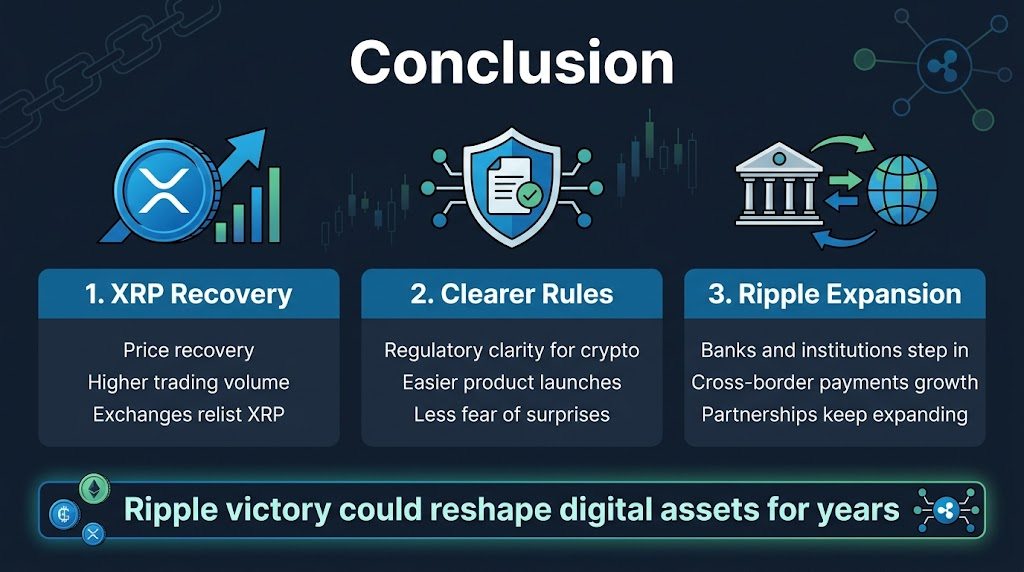
I've been watching the Ripple vs SEC case closely, and if Ripple comes out on top, we're looking at some major shifts across the crypto landscape. The most obvious change would be XRP's price recovery and increased trading volume as exchanges feel confident listing it again. But the real game-changer goes beyond just one token – a Ripple victory would give the entire crypto industry much clearer rules to follow, making it easier for other companies to launch products without fear of regulatory surprises.
What excites me most is how this could open doors for Ripple's business expansion. Banks and financial institutions that have been sitting on the sidelines would likely jump in, knowing they won't face regulatory headaches. This puts Ripple in a sweet spot to dominate cross-border payments, especially since they've kept building partnerships even during the lawsuit. If you're invested in crypto or just curious about where the industry is headed, keep an eye on this case – the outcome could reshape how digital assets operate in the real world for years to come.
